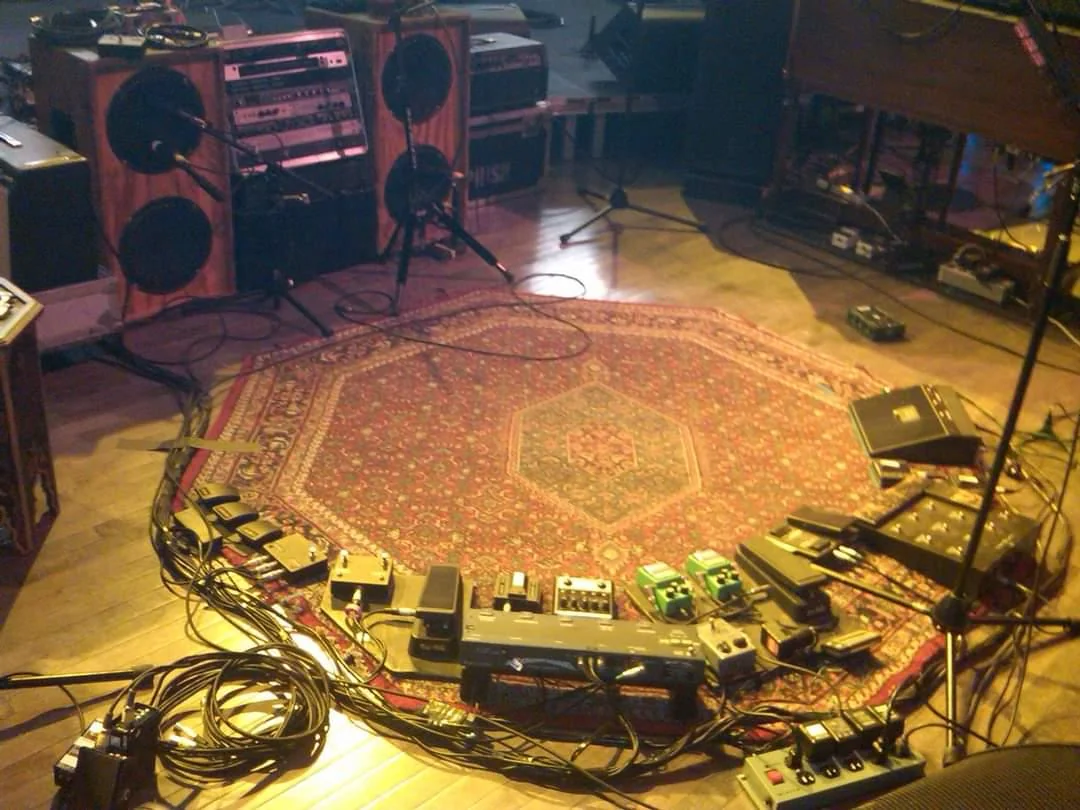
If you’ve watched Phish from the front row — or studied enough stage shots online — you’ve seen it. Sitting at the center of Trey Anastasio’s rig, ringed by effect pedals, cables, and amplifier cabinets, is an octagonal Persian rug that fans have come to call the Rocktagon.
It’s not merch. It’s not custom-made for the band. It’s a genuine hand-knotted Oriental rug, and it has quietly become one of the most recognizable stage elements in the Phish universe.
The Rug Itself
The Rocktagon is an octagonal hand-knotted Persian area rug in the Tabriz medallion style — one of the most celebrated and widely produced rug traditions in Iran. Its key visual features include:
- Shape: Octagonal, roughly 6–8 feet across, which fits neatly inside the footprint of Trey’s pedalboard arc and amp arrangement.
- Central medallion: A prominent hexagonal medallion at the center, rendered in cream and soft gold tones, surrounded by an intricate field of floral and arabesque motifs.
- Color palette: Dominated by warm reds, burnt oranges, and rust tones, with accents of cream, gold, and deep blue. Under stage lighting, the rug glows with a rich warmth that contrasts with the dark stage floor.
- Border: Multiple concentric border bands with repeating floral and geometric patterns, consistent with traditional Tabriz craftsmanship.
- Fringe: Visible knotted fringe along the edges, a hallmark of hand-knotted (as opposed to machine-made) construction.
Construction and Style
Tabriz rugs originate from the city of Tabriz in northwestern Iran, one of the oldest and most important rug-weaving centers in the world. Rugs in this tradition are typically:
- Hand-knotted using the Turkish (symmetrical) knot, though some Tabriz weavers use the Persian (asymmetrical) knot. Knot density varies, but quality Tabriz pieces often range from 120 to 400+ knots per square inch.
- Made from wool pile on a cotton foundation, though finer examples may incorporate silk highlights in the medallion or border areas.
- Designed with a formal, curvilinear aesthetic — flowing floral scrollwork, vine patterns (called islimi), and layered medallion compositions. This distinguishes them from the more geometric tribal rugs of other Iranian regions.
The octagonal shape is less common than rectangular or round formats in Persian rug production. Octagonal rugs are typically custom-cut or woven to order, making the Rocktagon a somewhat unusual piece. The shape works perfectly for a stage setting — it defines Trey’s performance space in every direction without the dead corners of a rectangle.
Origins on Stage
Trey Anastasio has used Oriental rugs on stage for much of Phish’s career, following a long tradition in rock and jazz music. Musicians favor rugs for practical reasons: they dampen stage vibrations, prevent slipping, mark a consistent performance position, and provide a visual anchor within the rig.
The specific octagonal rug fans know as the Rocktagon became a fixture of Trey’s stage setup during Phish’s 3.0 era (the 2009 reunion onward). While Trey used various rectangular Oriental rugs in earlier eras, the distinctive octagonal shape made its consistent appearance as the band settled into the modern configuration of his rig — with the pedalboard arranged in a wide arc at his feet, the Languedoc guitar in hand, and the amp cabinets and Leslie speaker behind him.
The rug has been a constant presence through major Phish milestones: the Hampton reunion in 2009, countless MSG New Year’s runs, the Baker’s Dozen at Madison Square Garden in 2017, and the epic Sphere residency in 2024.
More Than a Rug
In 2024, fans noticed something unusual — at certain shows, the Rocktagon appeared to have been replaced or supplemented by a rumble pad, sparking immediate discussion across Phantasy Tour and Phish.net forums. The moment the rug was absent, people noticed. That’s how iconic it had become.
For the Phish community, the Rocktagon is more than floor covering. It’s the spot where Trey stands when he launches into a “Tweezer” jam that stretches past twenty minutes. It’s the ground zero of countless peak moments. It defines the physical space where the music happens.
It really ties the rig together.